
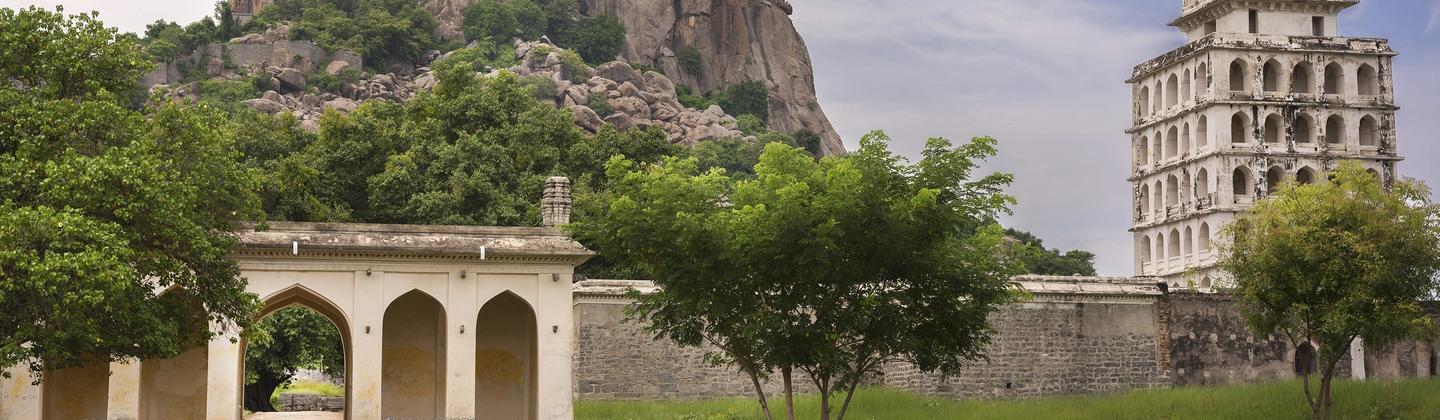
Gingee (Senji Fort)
Three granite hills joined by one great wall
A Gingee tour is built around Senji Fort, a three-hill citadel with a 13 km wall and a UNESCO World Heritage listing since 2025 for Maratha forts.
Overview
Gingee, also written Senji or Jinji, is a town in Villupuram district, Tamil Nadu, and its fort is the reason to come. In July 2025 UNESCO added the fort to its list as one of the twelve parts of the Maratha Military Landscapes of India, and it is the only one of the twelve outside Maharashtra. The place rewards history readers and anyone comfortable with a steep climb, and a winter visit, between November and February, is far kinder.
The fort spreads across three granite hills, Rajagiri, Krishnagiri and Chandrayandurg, which is also spelt Chakkilidurg. Walls about 13 km long tie the hills together around roughly 11 square kilometres, and an 80-foot moat is reported along the defences. Rajagiri is the tallest of the three and carries the main citadel. Local tradition credits a shepherd chief, Ananda Kone, with fortifying the site around the year 1200, and the district's tourism page says the fort gained its importance under the Nayaka rulers of the Vijayanagara period.
Control then passed from hand to hand. Shivaji took Gingee in 1677, and in the later centuries it was held by the Mughals, the Nawabs of Arcot, the French and the British. The lower fort holds the ruins of the Venkataramana temple, dated to the 1540s, and a mosque raised in 1717-18 by Sadat-Ullah Khan. The best-known building is the Kalyana Mahal, a tiered tower said to have seven storeys, and visitors also look for the granaries and the old prison cells. A small shrine to Chenjiamman sits at the top of Rajagiri.
The Archaeological Survey of India looks after the site. Reported hours and ticket prices differ between sources, so ask at the ticket counter on arrival rather than rely on a printed figure. Guides advise a morning start, because dusk comes quickly on the hill, and a water bottle, since nothing is sold at the top.
The town sits about 38 km from Villupuram and about 39 km from Tiruvannamalai, with Puducherry around 64 km away and Chennai between about 147 and 160 km. Tindivanam, about 28 km off, is the closest railway station named in the sources. A half day usually covers the lower fort and one hill, and the town fits easily into a route that also takes in Tiruvannamalai.
Known for
Three fortified hills joined by a wall of about 13 km
Quick facts
Cool and clear from November to February, when one travel guide gives 17 C to 28 C, and hotter from March to May.
Puducherry Airport at Lawspet, with flights listed to Hyderabad and Bengaluru; Gingee is about 64 km from Puducherry town (distance from the airport to be supplied). Chennai International Airport is the other option (distance to be supplied).
Tindivanam, about 28 km away; Villupuram (about 38 km) and Tiruvannamalai (about 39 km) are the other stations named
National Highway 77 (Krishnagiri to Puducherry) and State Highway 4 (Arcot to Villupuram) pass through Gingee. Chennai is about 147 to 160 km by road, depending on the source. Drive times (to be supplied).
Start the climb early in the morning and bring your own water and snacks, as nothing is sold at the top of Rajagiri
Wear shoes with a good grip for the granite steps and keep the descent for before dusk
Ask at the Archaeological Survey of India ticket counter which of the three hills and which buildings are open on the day, as sources disagree on hours
Location
Plan a trip to Gingee (Senji Fort)
Tell us your dates and we will shape the route.